ABRAHAM LINCOLN QUOTES II
U.S. President (1809-1865)
Notice: Undefined variable: id in /hermes/walnacweb03/walnacweb03ak/b2149/pow.notablequote/htdocs/l/includes/quoter.php on line 25
What is conservatism? Is it not adherence to the old and tried, against the new and untried?
ABRAHAM LINCOLN
Notice: Undefined variable: id in /hermes/walnacweb03/walnacweb03ak/b2149/pow.notablequote/htdocs/l/includes/quoter.php on line 35
speech, February 27, 1860
Notice: Undefined variable: id in /hermes/walnacweb03/walnacweb03ak/b2149/pow.notablequote/htdocs/l/includes/quoter.php on line 61
You say [slavery] is wrong; but don't you constantly object to anybody else saying so? Do you not constantly argue that this is not the right place to oppose it? You say it must not be opposed in the free States, because slavery is not there; it must not be opposed in the slave States, because it is there; it must not be opposed in politics, because that will make a fuss; it must not be opposed in the pulpit, because it is not religion. Then where is the place to oppose it?
ABRAHAM LINCOLN
debate with Stephen Douglas, October 13, 1858
Labor is prior to, and independent of, capital. Capital is only the fruit of labor and could never have existed if labor had not first existed. Labor is the superior of capital, and deserves much the higher consideration.
ABRAHAM LINCOLN
annual message, December 3, 1861
No man is good enough to govern another man, without that other's consent. I say this is the leading principle--the sheet anchor of American republicanism.
ABRAHAM LINCOLN
speech at Peoria, Illinois, in reply to Senator Douglas, October 16, 1854
We shall sooner have the bird by hatching the egg than by smashing it.
ABRAHAM LINCOLN
attributed, Wit and Wisdom of the American Presidents
When you have got an elephant by the hind leg, and he is trying to run away, it's best to let him run.
ABRAHAM LINCOLN
attributed, Recollections of the Civil War
In great contests each party claims to act in accordance with the will of God. Both may be, and one must be, wrong. God cannot be for and against the same thing at the same time.
ABRAHAM LINCOLN
meditation on the will of God, September 1862
I never encourage deceit, and falsehood, especially if you have got a bad memory, is the worst enemy a fellow can have. The fact is truth is your truest friend, no matter what the circumstances are.
ABRAHAM LINCOLN
letter to George E. Pickett, February 22, 1841
It is best not to swap horses while crossing the river.
ABRAHAM LINCOLN
reply to National Union League, June 9, 1864
He who makes an assertion without knowing whether it is true or false, is guilty of falsehood; and the accidental truth of the assertion, does not justify or excuse him.
ABRAHAM LINCOLN
letter to Allen N. Ford, August 11, 1846
I wish you to remember, now and forever, that it is your business, and not mine; that if the union of these states and the liberties of this people shall be lost, it is but little to any one man of fifty-two years of age, but a great deal to the thirty millions of people who inhabit these United States and to their posterity in all coming time. It is your business to rise up and preserve the Union and liberty for yourselves and not for me. I appeal to you again to constantly bear in mind that not with politicians, not with Presidents, not with office seekers, but with you, is the question: Shall the Union and shall the liberties of this country be preserved to the latest generations?
ABRAHAM LINCOLN
speech, February 11, 1861
Capital has its rights, which are as worthy of protection as any other right.
ABRAHAM LINCOLN
speech to Congress, December 3, 1861
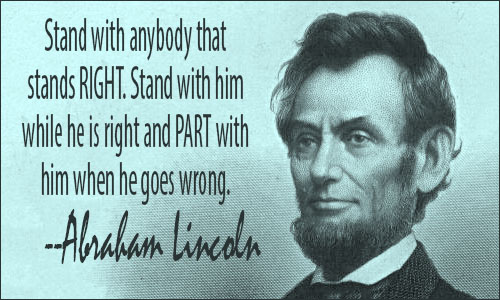
Stand with anybody that stands RIGHT. Stand with him while he is right and PART with him when he goes wrong.
ABRAHAM LINCOLN
speech at Peoria, Illinois, in reply to Senator Douglas, October 16, 1854
If we have no friends, we have no pleasure; and if we have them, we are sure to lose them, and be doubly pained by the loss.
ABRAHAM LINCOLN
letter to Joshua F. Speed, February 25, 1842
The better part of one's life consists of his friendships.
ABRAHAM LINCOLN
letter to Joseph Gillespie, July 13, 1849
With malice toward none; with charity for all; with firmness in the right, as God gives us to see the right, let us strive on to finish the work we are in; to bind up the nation's wounds; to care for him who shall have borne the battle, and for his widow, and his orphan--to do all which may achieve and cherish a just and lasting peace among ourselves, and with all nations.
ABRAHAM LINCOLN
Second Inaugural Address, March 4, 1865
Few can be induced to labor exclusively for posterity; and none will do it enthusiastically. Posterity has done nothing for us; and theorize on it as we may, practically we shall do very little for it, unless we are made to think we are at the same time doing something for ourselves.
ABRAHAM LINCOLN
speech, February 22, 1842
Neither party expected for the war the magnitude or the duration which it has already attained. Neither anticipated that the cause of the conflict might cease with, or even before, the conflict itself should cease. Each looked for an easier triumph, and a result less fundamental and astounding. Both read the same Bible, and pray to the same God; and each invokes his aid against the other. It may seem strange that any men should dare to ask a just God's assistance in wringing their bread from the sweat of other men's faces; but let us judge not, that we be not judged. The prayers of both could not be answered--that of neither has been answered fully. The Almighty has his own purposes.
ABRAHAM LINCOLN
Second Inaugural Address, March 4, 1865
The one victory we can ever call complete will be that one which proclaims that there is not one slave or one drunkard on the face of God's green earth.
ABRAHAM LINCOLN
letter to George E. Pickett, February 22, 1841
Received as I am by the members of a legislature the majority of whom do not agree with me in political sentiments, I trust that I may have their assistance in piloting the ship of state through this voyage, surrounded by perils as it is; for if it should suffer wreck now, there will be no pilot ever needed for another voyage.
ABRAHAM LINCOLN
speech, February 21, 1861