TIME TRAVEL QUOTES
quotations about time travel
When I am out there, in time, I am inverted, changed into a desperate version of myself. I become a thief, a vagrant, an animal who runs and hides. I startle old women and amaze children. I am a trick, an illusion of the highest order, so incredible that I am actually true.
AUDREY NIFFENEGGER
The Time Traveler's Wife
Time travel ... will never be impossible forever.
TOBA BETA
Betelgeuse Incident
What use was time to those who'd soon achieve Digital Immortality?
CLYDE DESOUZA
Memories with Maya
The truth is, time travel is hard, and people are lazy.
MARGARET PETERSON HADDIX
Redeemed
Come here, cat. You wouldn't want to destroy the space-time continuum, would you? Meow. Meow.
CONNIE WILLIS
To Say Nothing of the Dog
Once confined to fantasy and science fiction, time travel is now simply an engineering problem.
MICHIO KAKU
Wired Magazine, August 2003
WOMAN: How does time travel work, anyway? Impossible and absurd, I've read.
TIME TRAVELER: According to today's physics and logic, that's true. They'll learn better in the future.
POUL ANDERSON
The Shield of Time
How do you decide whether tomorrow's technology includes time travel? Where do you look for evidence that our descendants have discovered the means of temporal voyaging? If time travel is a one-way process forward, there is no way we can know. If, as the new physics suggest, it is possible to move back in time, then the evidence we are searching for will present itself as anachronisms. Human beings are careless. They drop things they shouldn't, like the metal tubes found in Saint-Jean de Livet in France. They are also vulnerable. Whatever safeguards are in place, sooner or later someone will be trapped in a time period other than their own and die there. If the time period is historical, their death will leave no anachronistic trace, but if we examine the depths of prehistory, it becomes possible to trace the series of temporal disasters which left a trail of corpses where they decidedly should not be.
J. H. BRENNAN
Time Travel: A New Perspective
It's this simple: Spacetime implies the possibility of time travel. How it would happen is a question for another time.
DILIP D'SOUZA
"How realistic is the idea of time travel?", Live Mint, May 19, 2017
Time is not a line but a dimension, like the dimensions of space. If you can bend space you can bend time also, and if you knew enough and could move faster than light you could travel backward in time and exist in two places at once.
MARGARET ATWOOD
Cat's Eye
A much-voiced objection to travel backwards in time is that we don't encounter anybody from the future. If it were possible to visit the past, we might expect that our descendants, perhaps thousands of years from now, would build a time machine and come back to observe us, or even to tell us about themselves. Key historical events such as the Crucifixion would have been crowded by throngs of eager witnesses. Discounting reports of ghosts, UFOs, and the like, the apparent absense of time tourists is something of a problem for time travel enthusiasts. Fortunately this objection is easily met in the case of wormhole time machines. Although wormholes could be used to go back and forth in time, it is not possible to use one to visit a time before the wormhole was constructed. If we built one now, and established, say, a one-hundred-year time difference between the two ends, then in one hundred years someone could revisit 2001. But you couldn't use the wormhole to go back and see the dinosaurs. Only if wormhole time machines already exist in nature--or were made long ago by an alien civilization--could we visit epochs before the present. So if the first wormhole time machine were built in the year 3000, there could not be any time tourists in the year 2000.
PAUL DAVIES
How to Build a Time Machine
What would happen if history could be rewritten as casually as erasing a blackboard? Our past would be like the shifting sands at the seashore, constantly blown this way or that by the slightest breeze. History would be constantly changing every time someone spun the dial of a time machine and blundered his or her way into the past. History, as we know it, would be impossible. It would cease to exist.
MICHIO KAKU
Hyperspace
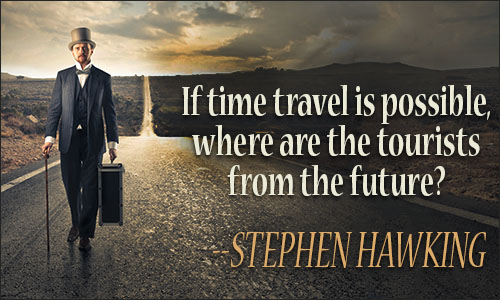
If time travel is possible, where are the tourists from the future?
STEPHEN HAWKING
A Brief History of Time
Identified with our bodies, which are limited in space and time, we sentient beings have lost the experience (if it can be called that) of residing in timeless, spaceless eternity (now being investigated by physicists studying superstring theory and quantum physics, although they may not think of it in this manner). Time travel frees us from such limitations. This freedom typically occurs when we practice any spiritual discipline that alters the relation between body and mind ... It allows us to move through time and to improve our quality of life by revisiting past errors and learning to forgive ourselves and others.
FRED ALAN WOLF
The Yoga of Time Travel: How the Mind Can Defeat Time
If we could travel into the past, it's mind-boggling what would be possible. For one thing, history would become an experimental science, which it certainly isn't today. The possible insights into our own past and nature and origins would be dazzling. For another, we would be facing the deep paradoxes of interfering with the scheme of causality that has led to our own time and ourselves. I have no idea whether it's possible, but it's certainly worth exploring.
CARL SAGAN
interview, NOVA, October 12, 1999
He made that pffft Parisian cabbies make
in early August, when Americans
try to parlez avec them at rush hour.
He gave me a long over-the-shoulder glare,
squeezed the steering wheel, and hit the gas.
He said, He's wrong. The one thing that would work
is to fly faster than the speed of light,
through a wormhole. The gravitational field
is full of holes: You only have to find
one and be pulled by metagravitational force.
For energy you could use a compressed song...
(or words to that effect. My memory
isn't what it was ten minutes ago).
MARILYN NELSON
"Faster than Light", The Cachoeira Tales and Other Poems
The milestones passing left and right,
They mark your flight through time...
So just relax, enjoy the flight.
Time travel's not a crime.
ROBERT H. OLANDER
"Time Travel", The Traveler and Other Poems
If time travel is possible, why not flag a certain place and time in history and invite time travelers to attend? As long as information on the event percolated into the future--and a combination of Internet, print media, and TV coverage would seem to guarantee this unless our civilization were destroyed--how could any time traveler resist?
BRIAN CLEGG
How to Build a Time Machine: The Real Science of Time Travel
Shh! Listen! Someone's coming! I think -- I think it might be us!
J. K. ROWLING
Harry Potter and the Prisoner of Azkaban
If time travel ever became widespread, English grammar was going to have to add a whole new set of tenses to describe reflexive situations -- conjugations that would make the French literary tenses and the Latin historical tenses look simple.
ROBERT A. HEINLEIN
The Door Into Summer