ABSURDISM QUOTES
quotations about absurdism
Notice: Undefined variable: id in /hermes/walnacweb03/walnacweb03ak/b2149/pow.notablequote/htdocs/a/includes/quoter_subj.php on line 27
Absurdity is the new sublime. The good news is that, while other resources are dwindling, absurdity is multiplying and flourishing and filling the earth.
MICHAEL FOLEY
Notice: Undefined variable: id in /hermes/walnacweb03/walnacweb03ak/b2149/pow.notablequote/htdocs/a/includes/quoter_subj.php on line 37
The Age of Absurdity
Notice: Undefined variable: id in /hermes/walnacweb03/walnacweb03ak/b2149/pow.notablequote/htdocs/a/includes/quoter_subj.php on line 63
Notice: Undefined index: bio in /hermes/walnacweb03/walnacweb03ak/b2149/pow.notablequote/htdocs/a/includes/quoter_subj.php on line 65
Notice: Undefined variable: id in /hermes/walnacweb03/walnacweb03ak/b2149/pow.notablequote/htdocs/a/includes/quoter_subj.php on line 69
Notice: Undefined index: bio in /hermes/walnacweb03/walnacweb03ak/b2149/pow.notablequote/htdocs/a/includes/quoter_subj.php on line 70
Absurdism is fine on its own, but it's antithetical to parody, which thrives on specificity -- knowing a subject well enough to echo, invert, and riff on it -- whereas absurdism thrives on randomness.
ALISON HERMAN
"David Wain Fans (and Maybe No One Else) Will Love Steve and Nancy Carell's Cop-Show Parody 'Angie Tribeca'", Flavorwire, January 15, 2016
Notice: Undefined index: bio in /hermes/walnacweb03/walnacweb03ak/b2149/pow.notablequote/htdocs/a/includes/quoter_subj.php on line 65
Notice: Undefined index: bio in /hermes/walnacweb03/walnacweb03ak/b2149/pow.notablequote/htdocs/a/includes/quoter_subj.php on line 70
In regard to absurdism, Samuel Beckett is sometimes considered to be the epitome of the postmodern artist ... In fact, he is the aesthetic reductio ad absurdum of absurdism: no longer whistling in the dark, after waiting for Godot, he is trying to be radically silent, wordless in the dark. Beckett tries to bespeak a failure of the logos that never quite succeeds in being a failure, for to speak the failure would be a kind of success. Hence the essentially comic (hence unavoidably and ultimately affirmative) nature of his work.
WILLIAM DESMOND
Philosophy and Its Others
Notice: Undefined index: bio in /hermes/walnacweb03/walnacweb03ak/b2149/pow.notablequote/htdocs/a/includes/quoter_subj.php on line 65
Notice: Undefined index: bio in /hermes/walnacweb03/walnacweb03ak/b2149/pow.notablequote/htdocs/a/includes/quoter_subj.php on line 70
Absurdism, I would argue, itself is a strategic domestication of modernism. The category subsumes a heterogeneous body of intensely specific works under a series of unequivocal generalizations. With its user-friendly philosophical precepts, absurdism allows a reassuring aura of meaningfulness to emerge from recalcitrant works.
VARUN BEGLEY
Harold Pinter and the Twilight of Modernism
Notice: Undefined index: bio in /hermes/walnacweb03/walnacweb03ak/b2149/pow.notablequote/htdocs/a/includes/quoter_subj.php on line 65
Notice: Undefined index: bio in /hermes/walnacweb03/walnacweb03ak/b2149/pow.notablequote/htdocs/a/includes/quoter_subj.php on line 70
The absurdist is concerned with the search for meaning in the Universe. He believes this search to be meaningless--hence the disintegration of plot, character, and language in absurdist drama. Order is a falsehood that we, God, those who came before, have imposed on a random universe. However, the absurdist is confronted with a curious paradox: though he believes the Universe to be meaningless, he cannot abandon the search for meaning--or he will die.
WALTER WYKES
artist statement, 1998
Notice: Undefined index: bio in /hermes/walnacweb03/walnacweb03ak/b2149/pow.notablequote/htdocs/a/includes/quoter_subj.php on line 65
Notice: Undefined index: bio in /hermes/walnacweb03/walnacweb03ak/b2149/pow.notablequote/htdocs/a/includes/quoter_subj.php on line 70
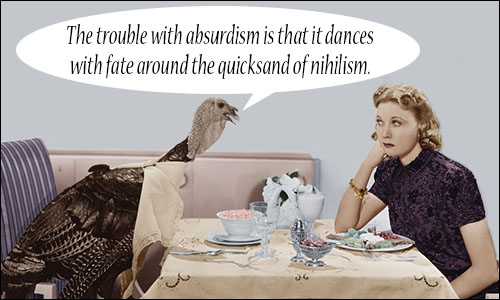
The trouble with absurdism is that it dances with fate around the quicksand of nihilism.
JOE KINCHELOE
"Fiction Formulas"
Notice: Undefined index: bio in /hermes/walnacweb03/walnacweb03ak/b2149/pow.notablequote/htdocs/a/includes/quoter_subj.php on line 65
Notice: Undefined index: bio in /hermes/walnacweb03/walnacweb03ak/b2149/pow.notablequote/htdocs/a/includes/quoter_subj.php on line 70
The Theatre of the Absurd has renounced arguing about the absurdity of the human condition; it merely presents it in being--that is, in terms of concrete stage images. This is the difference between the approach of the philosopher and that of the poet.
MARTIN ESSLIN
The Theatre of the Absurd
Notice: Undefined index: bio in /hermes/walnacweb03/walnacweb03ak/b2149/pow.notablequote/htdocs/a/includes/quoter_subj.php on line 65
Notice: Undefined index: bio in /hermes/walnacweb03/walnacweb03ak/b2149/pow.notablequote/htdocs/a/includes/quoter_subj.php on line 70
Absurdism, like methodical doubt, has wiped the slate clean. It leaves us in a blind alley. But, like methodical doubt, it can, by returning upon itself, open up a new field of investigation, and in the process of reasoning then pursues the same course. I proclaim that I believe in nothing and that everything is absurd, but I cannot doubt the validity of my proclamation and I must at least believe in my protest.
ALBERT CAMUS
The Rebel
Notice: Undefined index: bio in /hermes/walnacweb03/walnacweb03ak/b2149/pow.notablequote/htdocs/a/includes/quoter_subj.php on line 65
Notice: Undefined index: bio in /hermes/walnacweb03/walnacweb03ak/b2149/pow.notablequote/htdocs/a/includes/quoter_subj.php on line 70
The Theatre of the Absurd ... can be seen as the reflection of what seems to be the attitude most genuinely representative of our own time. The hallmark of this attitude is its sense that the certitudes and unshakable basic assumptions of former ages have been swept away, that they have been tested and found wanting, that they have been discredited as cheap and somewhat childish illusions.
MARTIN ESSLIN
The Theatre of the Absurd
Notice: Undefined index: bio in /hermes/walnacweb03/walnacweb03ak/b2149/pow.notablequote/htdocs/a/includes/quoter_subj.php on line 65
Notice: Undefined index: bio in /hermes/walnacweb03/walnacweb03ak/b2149/pow.notablequote/htdocs/a/includes/quoter_subj.php on line 70
Whereas Absurdism in Europe seemed a logical, almost inevitable response to the irrationality of war, the analogous elements that surfaced in American drama seemed more a response to a materialist society run amok. The American-style Absurdism seemed to spring full-blown out of television advertisements and situation comedies, which had become new myth-making machines.
ARNOLD ARONSON
The Cambridge History of American Theatre
Notice: Undefined index: bio in /hermes/walnacweb03/walnacweb03ak/b2149/pow.notablequote/htdocs/a/includes/quoter_subj.php on line 65
Notice: Undefined index: bio in /hermes/walnacweb03/walnacweb03ak/b2149/pow.notablequote/htdocs/a/includes/quoter_subj.php on line 70
Nihilism consists in that path leading humankind toward extinction, while absurdism is that path that leads toward continued, lively exertion.
JOHN MARMYSZ
Laughing at Nothing: Humor as a Response to Nihilism
Notice: Undefined index: bio in /hermes/walnacweb03/walnacweb03ak/b2149/pow.notablequote/htdocs/a/includes/quoter_subj.php on line 65
Notice: Undefined index: bio in /hermes/walnacweb03/walnacweb03ak/b2149/pow.notablequote/htdocs/a/includes/quoter_subj.php on line 70
Should I kill myself or have a cup of coffee?
ANONYMOUS
often falsely attributed to Albert Camus
Notice: Undefined index: bio in /hermes/walnacweb03/walnacweb03ak/b2149/pow.notablequote/htdocs/a/includes/quoter_subj.php on line 65
Notice: Undefined index: bio in /hermes/walnacweb03/walnacweb03ak/b2149/pow.notablequote/htdocs/a/includes/quoter_subj.php on line 70
I love you all and I deeply implore you to keep the lasagna flying. Please pardon my levity, I don't see how to take death seriously. It seems absurd.
ROBERT ANTON WILSON
final blog entry, "Do Not Go Gently Into That Good Night", January 6, 2007
Notice: Undefined index: bio in /hermes/walnacweb03/walnacweb03ak/b2149/pow.notablequote/htdocs/a/includes/quoter_subj.php on line 65
Notice: Undefined index: bio in /hermes/walnacweb03/walnacweb03ak/b2149/pow.notablequote/htdocs/a/includes/quoter_subj.php on line 70
There are no exact guidelines. There are probably no guidelines at all. The only thing I can recommend at this stage is a sense of humor, an ability to see things in their ridiculous and absurd dimensions, to laugh at others and at ourselves.
VACLAV HAVEL
address upon receiving the Open Society Prize awarded by Central European University, June 24, 1999
Notice: Undefined index: bio in /hermes/walnacweb03/walnacweb03ak/b2149/pow.notablequote/htdocs/a/includes/quoter_subj.php on line 65
Notice: Undefined index: bio in /hermes/walnacweb03/walnacweb03ak/b2149/pow.notablequote/htdocs/a/includes/quoter_subj.php on line 70
Realism provides only amoral observation, while Absurdism rejects even the possibility of debate.
FRANCES BABBAGE
Augusto Boal
Notice: Undefined index: bio in /hermes/walnacweb03/walnacweb03ak/b2149/pow.notablequote/htdocs/a/includes/quoter_subj.php on line 65
Notice: Undefined index: bio in /hermes/walnacweb03/walnacweb03ak/b2149/pow.notablequote/htdocs/a/includes/quoter_subj.php on line 70
The Theatre of the Absurd attacks the comfortable certainties of religious or political orthodoxy. It aims to shock its audience out of complacency, to bring it face to face with the harsh facts of the human situation as these writers see it. But the challenge behind this message is anything but one of despair. It is a challenge to accept the human condition as it is, in all its mystery and absurdity, and to bear it with dignity, nobly, responsibly; precisely because there are no easy solutions to the mysteries of existence, because ultimately man is alone in a meaningless world. The shedding of easy solutions, of comforting illusions, may be painful, but it leaves behind it a sense of freedom and relief. And that is why, in the last resort, the Theatre of the Absurd does not provoke tears of despair but the laughter of liberation.
MARTIN ESSLIN
introduction, Absurd Drama
Notice: Undefined index: bio in /hermes/walnacweb03/walnacweb03ak/b2149/pow.notablequote/htdocs/a/includes/quoter_subj.php on line 65
Notice: Undefined index: bio in /hermes/walnacweb03/walnacweb03ak/b2149/pow.notablequote/htdocs/a/includes/quoter_subj.php on line 70
The absurd is a category, the negative criterion, of the divine or of the relationship to the divine. When the believer has faith, the absurd is not the absurd -- faith transforms it, but in every weak moment it is again more or less absurd to him.
SOREN KIERKEGAARD
Journals of Soren Kierkegaard
Notice: Undefined index: bio in /hermes/walnacweb03/walnacweb03ak/b2149/pow.notablequote/htdocs/a/includes/quoter_subj.php on line 65
Notice: Undefined index: bio in /hermes/walnacweb03/walnacweb03ak/b2149/pow.notablequote/htdocs/a/includes/quoter_subj.php on line 70
An incomprehensible universe is best reflected in an incomprehensible story.
FRANCIS M. NEVINS JR.
introduction, Night and Fear: A Centenary Collection of Stories
Notice: Undefined index: bio in /hermes/walnacweb03/walnacweb03ak/b2149/pow.notablequote/htdocs/a/includes/quoter_subj.php on line 65
Notice: Undefined index: bio in /hermes/walnacweb03/walnacweb03ak/b2149/pow.notablequote/htdocs/a/includes/quoter_subj.php on line 70
Existentialist humor is stoic; the Absurdist's is black. The former has tragic possibilities: the victim of the joke is noble and his suffering commendable. Black humor verges on despair: the victim is not noble but holding on, grim and pathetic but determined.
ROBERT A. HIPKISS
The American Absurd: Pynchon, Vonnegut, and Barth
Notice: Undefined index: bio in /hermes/walnacweb03/walnacweb03ak/b2149/pow.notablequote/htdocs/a/includes/quoter_subj.php on line 65
Notice: Undefined index: bio in /hermes/walnacweb03/walnacweb03ak/b2149/pow.notablequote/htdocs/a/includes/quoter_subj.php on line 70
The Gospel of absurdism is to keep on chugging, defiant to the end.
ADAM SETSER
"Albert Camus and the Philosophy of the Absurd"
Notice: Undefined index: bio in /hermes/walnacweb03/walnacweb03ak/b2149/pow.notablequote/htdocs/a/includes/quoter_subj.php on line 65
Notice: Undefined index: bio in /hermes/walnacweb03/walnacweb03ak/b2149/pow.notablequote/htdocs/a/includes/quoter_subj.php on line 70