ZEN QUOTES
quotations about Zen
Notice: Undefined variable: id in /hermes/walnacweb03/walnacweb03ak/b2149/pow.notablequote/htdocs/z/includes/quoter_subj.php on line 27
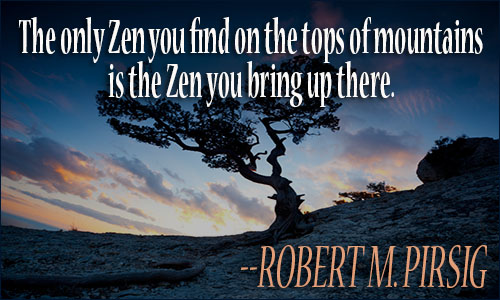
The only Zen you find on the tops of mountains is the Zen you bring up there.
ROBERT M. PIRSIG
Notice: Undefined variable: id in /hermes/walnacweb03/walnacweb03ak/b2149/pow.notablequote/htdocs/z/includes/quoter_subj.php on line 37
Zen and the Art of Motorcycle Maintenance
Notice: Undefined variable: id in /hermes/walnacweb03/walnacweb03ak/b2149/pow.notablequote/htdocs/z/includes/quoter_subj.php on line 63
Robert M. Pirsig (September 6, 1928 - April 24, 2017) was an American writer and philosopher whose published work consists most notably of two books. The better known, Zen and the Art of Motorcycle Maintenance, delves into into the nature of quality. Ostensibly a first-person narrative based on a motorcycle trip he and his young son had taken from Minneapolis to San Francisco, it is an exploration of the underlying metaphysics of Western culture.
Notice: Undefined variable: id in /hermes/walnacweb03/walnacweb03ak/b2149/pow.notablequote/htdocs/z/includes/quoter_subj.php on line 69
Notice: Undefined variable: id in /hermes/walnacweb03/walnacweb03ak/b2149/pow.notablequote/htdocs/z/includes/quoter_subj.php on line 71
No matter what verbal space you try to enclose Zen in, it resists, and spills over ... the Zen attitude is that words and truth are incompatible, or at least that no words can capture truth.
DOUGLAS HOFSTADTER
Godel, Escher, Bach: an Eternal Golden Braid
Douglas Hofstadter (born February 15, 1945) is an American scholar of cognitive science, physics, and comparative literature whose research includes concepts such as the sense of self in relation to the external world, consciousness, analogy-making, artistic creation, literary translation, and discovery in mathematics and physics. His 1979 book Gödel, Escher, Bach: An Eternal Golden Braid won both the Pulitzer Prize for general nonfiction and a National Book Award for Science.
There is a moment, perhaps an era of enlightenment that arrives, eventually in Zen. It is a sensation that one is above the paradox, able to handle mystery without question.
TOM HENDERSON
"Zen and the Art of Security", Network World, December 13, 2017
Zen lives in the present. The Whole teaching is: how to be in the present; how to get out of the past which is no more and how not to get involved in the future which is not yet, and just to be rooted, centered, in that which is.
OSHO
Zen: The Path of Paradox
Osho (11 December 1931 - 19 January 1990) was an Indian godman, mystic, and founder of the Rajneesh movement. He emphasized the importance of meditation, mindfulness, love, celebration, courage, creativity, and humor--qualities that he viewed as being suppressed by adherence to static belief systems and religious tradition. In advocating a more open attitude to human sexuality, he caused controversy in India during the late 1960s and became known as "the sex guru".
Zen is to religion what a Japanese "rock garden" is to a garden. Zen knows no god, no afterlife, no good and no evil, as the rock-garden knows no flowers, herbs or shrubs. It has no doctrine or holy writ: its teaching is transmitted mainly in the form of parables as ambiguous as the pebbles in the rock-garden which symbolise now a mountain, now a fleeting tiger. When a disciple asks "What is Zen?", the master's traditional answer is "Three pounds of flax" or "A decaying noodle" or "A toilet stick" or a whack on the pupil's head.
ARTHUR KOESTLER
"A Taste of Zen", Bricks to Babel
Arthur Koestler, (5 September 1905 - 1 March 1983) was a Hungarian British author and journalist. In 1940, his anti-totalitarian novel Darkness at Noon brought him international fame. Over the next 43 years, from his residence in Britain, Koestler espoused many political causes and wrote novels, memoirs, biographies, and numerous essays. In 1968, he was awarded the Sonning Prize for his "outstanding contribution to European culture," and in 1972, he was made a Commander of the Order of the British Empire.
Zen is more concerned with attaining wisdom through doing, in that daily life and mundane tasks will teach you more than any sacred text could.
BRIAN CLARK
"Zen and the Art of Remarkable Blogging", Copyblogger, March 27, 2017
Brian Clark is the founder and CEO of the content marketing website Copyblogger, the personal growth newsletter Further, and Unemployable, a resource that provides smart strategies for freelancers and entrepreneurs.
The study of Zen is a highly complicated endeavor that for centuries has been accomplished solely through direct one-on-one conversation with one's master. You can take notes, but these notes are extremely private and not to be shared.
MEGAN VOLPERT
"Ancient Mysteries (Sort of) Revealed", Pop Matters, February 27, 2017
Megan Volpert is author or editor of over a dozen books on popular culture, including two Lambda Literary Award finalists and an American Library Association honoree. She writes for PopMatters and has edited anthologies of philosophical essays on the music of Tom Petty and the television series RuPaul's Drag Race.
Zen taught me how to pay attention, how to delve, how to question and enter, how to stay with -- or at least want to try to stay with -- whatever is going on.
JANE HIRSHFIELD
The Atlantic Online, Sep. 18, 1997
Jane Hirshfield (born 24 February 1953) is an American poet, essayist, and translator. In the award citation for Hirshfield's 2004 Academy of American Poets' Fellowship, Rosanna Warren noted: "Her poems appear simple, and are not. Her language, in its cleanliness and transparency, poses riddles of a quietly metaphysical nature."
Zen could be said to be the biggest joke that has ever been played in the spiritual realm. But it is a practical joke, very practical.
CHOGYAM TRUNGPA RINPOCHE
"Zen Mind, Vajra Mind", Lion's Roar, February 14, 2017
Chögyam Trungpa (March 5, 1939 - April 4, 1987) was a Tibetan Buddhist meditation master and holder of both the Kagyu and Nyingma lineages of Tibetan Buddhism. Among his contributions are the translation of numerous Tibetan Buddhist texts, the introduction of the Vajrayana teachings to the West, and establishing the Shambhala Training method.
Being like a zombie allowed me to attain a Zen state. I actualized the reality of my existence, in ways that only the reanimated can. I became the person I had always wanted to be ... by becoming like a zombie. In fact, the more like a zombie I acted, the better a person I became. And you can too.
SCOTT KENEMORE
The Zen of Zombie: (Even) Better Living through the Undead
Scott Kenemore (born 1977) is an American novelist and satirist, as well as an official member of the Zombie Research Society.
In Zen, poverty is voluntary, and considered not really as poverty so much as simplicity, freedom, unclutteredness.
ALAN WATTS
What Is Zen?
Alan Watts (6 January 1915 - 16 November 1973) was a British writer and speaker known for interpreting and popularizing Buddhism, Taoism, and Hinduism for a Western audience. He introduced the emerging hippie counterculture to The Way of Zen (1957) and explored human consciousness and psychedelics in works such as The New Alchemy (1958) and The Joyous Cosmology (1962).
When I say that Zen is life, I mean that Zen is not to be confined within conceptualization, that Zen is what makes conceptualization possible.
DAISETZ TEITARO SUZUKI
Zen Buddhism: Selected Writings of D.T. Suzuki
D. T. Suzuki (11 November 1870 - 12 July 1966) was a Japanese author of books and essays on Buddhism, Zen and Shin that were instrumental in spreading interest in Far Eastern philosophy to the West. He was also a prolific translator of Chinese, Japanese, and Sanskrit literature. Suzuki was nominated for the Nobel Peace Prize in 1963.
Zen is the practice of the ordinary mind. We take up the practice and we begin something both strange and mysteriously familiar, a path through the divided heart, with all the illusions and snares we set out for ourselves along the way.
JAMES FORD
"Kensho, Samadhi & the Practices of Zen", Patheos, January 13, 2017
James Ishmael Ford blogs as "Monkey Mind" on Patheos. The blog's motto is "easily distracted." It mostly addresses Zen life in the West, but also explores the currents of liberal and progressive religion, politics, and culture.
Not thinking about anything is Zen. Once you know this, walking, sitting, or lying down, everything you do is Zen.
BODHIDHARMA
The Zen Teaching of Bodhidharma
Bodhidharma was a semi-legendary Buddhist monk who lived during the 5th or 6th century. He is traditionally credited as the transmitter of Chan Buddhism to China, and regarded as its first Chinese patriarch.
For me, Zen is very practical. You can get very heady about it, and read all types of books, but for me, Zen is practice, grappling with the "monkey mind."
PAUL STUETZER
"Zen Center brings meditation, Buddhism to Silver City", Silver City Sun-News, January 31, 2016
Paul Stuetzer is an acupuncturist practicing in Silver City, NM. Dr. Stuetzer evaluates and treats patients based on the concepts of oriental medicine.
I have lived with several Zen masters -- all of them cats.
ECKHART TOLLE
The Power of Now: A Guide to Spiritual Enlightenment
Spiritual teacher Eckhart Tolle (born February 16, 1948) was depressed for much of his life until, at age 29, he experienced an "inner transformation". He then spent several years wandering "in a state of deep bliss" before writing The Power of Now and A New Earth, which sold an estimated three million and five million copies respectively.
When you are you, Zen is Zen.
SHUNRYU SUZUKI
introduction, Branching Streams Flow in the Darkness
Shunryū Suzuki (May 18, 1904 - December 4, 1971) was a Sōtō Zen monk and teacher who helped popularize Zen Buddhism in the United States. He founded San Francisco Zen Center which, along with its affiliate temples, comprises one of the most influential Zen organizations in the United States.
Zen is very easy! It's like touching your nose when you wash your face in the morning!
SEUNG SAHN
Wanting Enlightenment is a Big Mistake
Seung Sahn (August 1, 1927 - November 30, 2004) was a Korean Seon master of the Jogye Order and founder of the international Kwan Um School of Zen. He was the seventy-eighth Patriarch in his lineage. Known for his utilization of dharma combat and expressions such as "only don't know" or "only go straight" in teachings, he was conferred the honorific title of Dae Jong Sa in June 2004 by the Jogye Order for a lifetime of achievements.
To me Zen is a bit like the mikan trees that grow in our temple orchard. The mikan is a kind of mandarin orange that we harvest in late autumn. Every year, I make it a rule to take my son, Söjun, into the orchard to let him learn something of Zen from mikan-picking. At this time of the year, all the mikan branches are heavy with ripe fruit. Just looking at them makes me restless. I feel as though it were my urgent business to release each tree from its heavy burden. The drooping branch is my drooping heart. It's not good for a burdened heart to bear more than it has to. And like the bending mikan trees, the burden should not be carried indefinitely. Unload and just enjoy the freedom of it.
SOIKU SHIGEMATSU
introduction, A Zen Harvest
Sōiku Shigematsu (born October 13, 1943) is a Japanese priest of the Myoshin-ji branch of the Rinzai School of Zen Buddhism. His pioneering translation of the two most important Japanese collections of capping phrases or jakugo is acknowledged as the magnum opus of the contemporary English-speaking Zen world.
I always look at zen as a gift, a victory or something--like it's only achieved after everything is done.
ASHLEY BAKER
"Mark Anthony Green Gets Healed!", Fashion Week Daily, March 7, 2017