JOSEPH ADDISON QUOTES
English essayist, poet & playwright (1672-1719)
I think a Person who is thus terrified with the imagination of Ghosts and Spectres much more reasonable, than one who contrary to the Reports of all Historians sacred and profane, ancient and modern, and to the Traditions of all Nations, thinks the Appearance of Spirits fabulous and groundless.
JOSEPH ADDISON
The Spectator, 1711
The Fear of Death often proves Mortal.
JOSEPH ADDISON
The Spectator, Mar. 29, 1711
There is nothing we receive with so much reluctance as advice.
JOSEPH ADDISON
The Spectator, Oct. 12, 1712
Sweet are the slumbers of the virtuous man.
JOSEPH ADDISON
Cato
It would be a good appendix to the Art of Living and Dying, if any one would write the Art of Growing Old, and teach men to resign their pretensions to the pleasures and gallantries of youth, in proportion to the alteration they find in themselves by the approach of age and infirmities. The infirmities of this stage of life would be much fewer, if we did not affect those which attend the more vigorous and active part of our days; but, instead of studying to be wiser, or being contented with our present follies, the ambition of many of us is also to be the same sort of fools we formerly have been.
JOSEPH ADDISON
The Tatler, Dec. 21, 1710
Content thyself to be obscurely good. When vice prevails, and impious men bear sway, the post of honor is a private station.
JOSEPH ADDISON
Cato
Thus I live in the world rather as a spectator of mankind than as one of the species.
JOSEPH ADDISON
The Spectator, Mar 1, 1711
Were not this desire of fame very strong, the difficulty of obtaining it, and the danger of losing it when obtained, would be sufficient to deter a man from so vain a pursuit.
JOSEPH ADDISON
The Spectator, Dec. 22, 1711
There is not so variable a thing in Nature as a lady's head-dress.
JOSEPH ADDISON
The Spectator, Jun. 22, 1711
Unbounded courage and compassion join'd / Tempering each other in the victor's mind / Alternately proclaim him good and great / And make the hero and the man complete.
JOSEPH ADDISON
The Campaign
One hope no sooner dies in us but another rises up in its stead. We are apt to fancy that we shall be happy and satisfied if we possess ourselves of such and such particular enjoyments; but either by reason of their emptiness, or the natural inquietude of the mind, we have no sooner gained one point, but we extend our hopes to another. We still find new inviting scenes and landscapes lying behind those which at a distance terminated our view.
JOSEPH ADDISON
The Spectator, Nov. 13, 1712
Man is subject to innumerable pains and sorrows by the very condition of humanity, and yet, as if nature had not sown evils enough in life, we are continually adding grief to grief, and aggravating the common calamity by our cruel treatment of one another.
JOSEPH ADDISON
The Spectator, Sep. 13, 1711
Is there not some chosen curse, some hidden thunder in the stores of heaven, red with uncommon wrath, to blast the man who owes his greatness to his country's ruin?
JOSEPH ADDISON
Cato
Silence is sometimes more significant and sublime than the most noble and most expressive eloquence, and is on many occasions the indication of a great mind.
JOSEPH ADDISON
The Tatler, Feb. 14, 1709
Beauty soon grows familiar to the lover, fades in his eye, and palls upon the sense.
JOSEPH ADDISON
Cato
Admiration is a very short-lived passion that immediately decays upon growing familiar with its object, unless it be still fed with fresh discoveries, and kept alive by a new perpetual succession of miracles rising up to its view.
JOSEPH ADDISON
The Spectator, Dec. 24, 1711
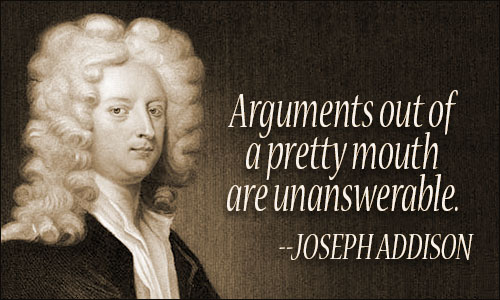
Arguments out of a pretty mouth are unanswerable.
JOSEPH ADDISON
The Freeholder, Jan. 2, 1716
What sculpture is to a block of marble, education is to the human soul.
JOSEPH ADDISON
The Spectator, Nov. 6, 1711
And pleas'd th' Almighty's orders to perform,
Rides in the whirlwind and directs the storm.
JOSEPH ADDISON
The Campaign
I have often wondered that learning is not thought a proper ingredient in the education of a woman of quality or fortune. Since they have the same improvable minds as the male part of their species.
JOSEPH ADDISON
The Guardian, Sep. 8, 1713